 Ελληνικά
 Deutsch
 Français
 Svenska
 Türkçe
 한국어
한국어 Suomi
Suomi






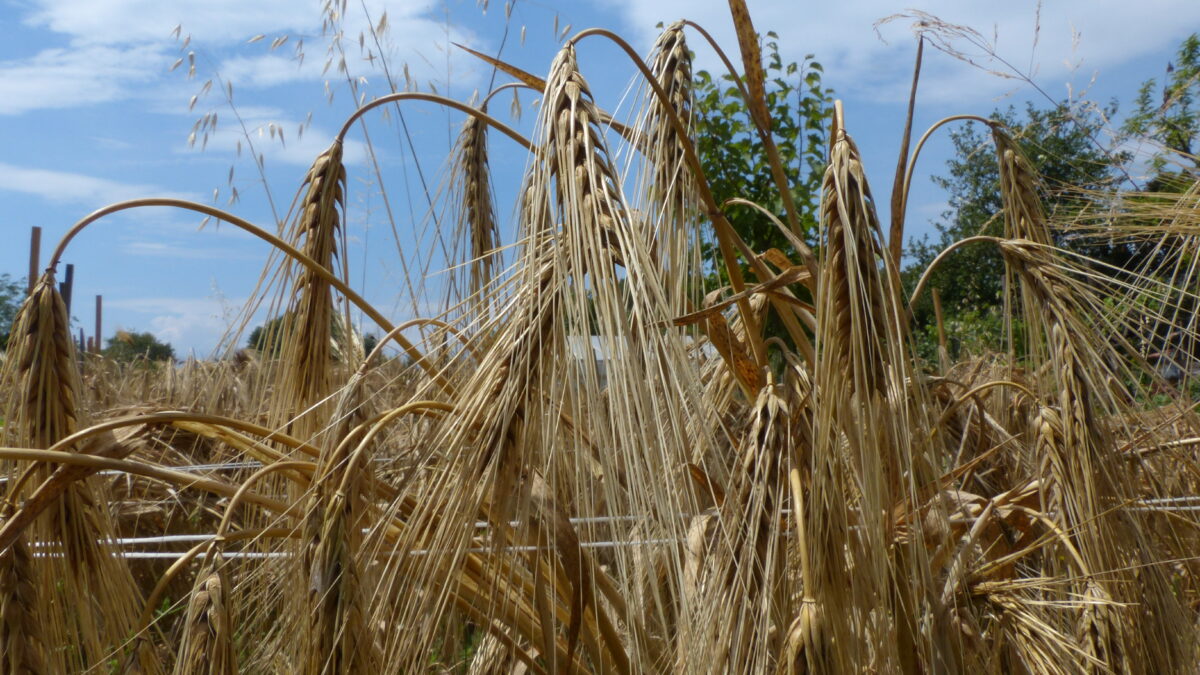
Image 1. Barley plants at the experimental AEGILOPS cultivations, Kato Lechonia, Pelion, summer 2014. Photograph by S.M. Valamoti, from the book Valamoti, S.M, Fyntikoglou V., Symponis, K. 2022. Food Crops in Ancient Greek Cuisine. Thessaloniki, University Studio Press.
Soultana-Maria Valamoti, Professor, School of History and Archaeology, Aristotle University of Thessaloniki
Barley was one of the earliest grains to be cultivated by the first farmers, and has thus been a staple of the eastern Mediterranean diet for millennia. It is for this reason, according to ancient Greek literature, that barley seeds, whether crushed or whole, constituted some of the earliest offerings to the gods. This practice has numerous attestations in ancient texts, salient examples being Homer’s Odyssey (8th c. B.C.), Aristophanes’ Peace (5th – 4th c. B.C.), Theophrastus’ On piety (4th – 3rd c. B.C.) and Herodotus’ History (5th c. B.C.). Barley was cultivated in prehistoric Greece since the early Neolithic period, while findings from the Mesolithic layers at Franchthi Cave have given rise to hypotheses concerning the domestication of the grain in and around the Aegean. Barley is frequently encountered in archaeological sites dating to the Neolithic period and the Bronze Age; in fact, findings from the late 3rd millennium B.C. seem to suggest that it was even used to make a form of beer.
The ancient Greeks consumed barley in numerous ways, from baked goods to soups. One especially prominent preparation made of barley was known as μάζα. The word itself suggests kneading, as it is drawn from the verb μάσσω, meaning to knead. It is first attested in Hesiod’s Works and Days (8th – 7th c. B.C.), which mentions a maza kneaded with milk (μάζα αμολγαίη). A verse of Archilochus preserves a reference to a hoplite who skewered a piece of maza with his spear (7th c. B.C.).
So, what exactly was this ancient Greek maza? This foodstuff became so intertwined with the Greeks that centuries later, the Romans looked down upon it, differentiating themselves from their Mediterranean neighbours who consumed it. Ancient texts discern between barley maza and wheat bread, as is the case in the works of Hippocrates (5th – 4th c. B.C.) even though both products involve mixing cracked grains and water. Put simply, maza was made of ground barley seeds mixed with a liquid medium, such as water, milk, honey, or wine. As such, in Aristophanes’ Plutus (5th – 4th c. B.C.) there are references to maza made with wine, water, and oil, while in his Clouds maza is described as being prepared with ground barley and honey. The Athenians made monthly ritual offerings of honey maza to the serpent guardian of the Acropolis, leaving them at the sanctuary where it lived, according to Herodotus (5th c. B.C.). There are numerous references to and descriptions of maza in the Hippocratic corpus (5th – 4th c. B.C.), painting a picture of the myriad ways in which it could be consumed: dried, wet, sticky, baked, ground, airy, or soft. Maza also appears frequently in ancient comedy, another indication of its widespread consumption in ancient Greece.
The maza of the ancient Greeks does not have any direct parallels in modern Greek cuisine; perhaps the closest modern-day equivalent is the Tibetan tsampa.