 Ελληνικά
 Deutsch
 Français
 Svenska
 Türkçe
 한국어
한국어 Suomi
Suomi






Soultana-Maria Valamoti, Professor, School of History and Archaeology, Aristotle University of Thessaloniki
Cornelian cherries are indigenous to both Greece and Europe. Archaeobotanical remains of Cornelian cherries, specifically their pits, have been found at Mavropigi-Fyllotsairi, a Neolithic site in Western Macedonia dated to roughly the mid-7th millennium B.C. While Cornelian cherries discovered in the course of archaeological digs are limited, it is almost certain that they were regularly gathered by prehistoric populations. A large quantity of the fruit was discovered at the lake settlement of Anargyroi, in the four lakes region of Florina, where it was preserved due to waterlogging; evidence that the inhabitants of prehistoric Macedonia knew of and regularly collected the fruit.
The ancient word for Cornelian cherry tree, κράν(ε)ια, is almost identical to its modern Greek counterpart. It crops up in ancient Greek literature as early as the 8th c. B.C. and the Homeric epics. There is a mention in the Iliad of the tanyfloion kraneian (the Cornelian cherry, with its smooth or thin bark), while in the Odyssey, the witch Circe transformed Odysseus’ crewmen into swine by feeding them a mixture of Cornelian cherries and acorns. There are numerous references to weapons fashioned out of the wood of the Cornelian cherry tree already from the Homeric Hymn to Hermes, which mentions a spear (v. 460, kraneinon akontion). Writers of the 5th century discuss weapons made of Cornelian cherry wood, such as a bow in a passage from Euripides (and Lycian bows in Herodotus), or other projectile weapons (used by the Persians as described in the Hellenica and the Cyropaedia, but also in the De equis alendis) or hunting tools (Cynegeticus) as Xenophon relates. The historian Ctesias (5th/4th c. B.C.) describes the hunting tools used by the Indians, which were made of Cornelian cherry, as exceptionally durable (κρανείας δέ ἐστι ταῦτα, ίσχυρἀ ἄγαν). This is also confirmed by Theophrastus (Enquiry into plants), while Pausanias (2nd c. A.D.) shares the same opinion in his Description of Greece, relating that according to one account, the Greeks fashioned the Trojan horse out of Cornelian cherry trees cut from Apollo’s sacred grove, an act which raised the god’s ire.
References to the Cornelian cherry are rather few and far between in the classical literature, a fact that is also true to a greater extent for the terms kranon (which signifies the tree) and kran(e)ion. For example, in the passage of the Odyssey mentioned above, Cornelian cherries are referred to as “καρπόν κρανείης”, while in comedy, where references to foods are frequent, the tree –not its fruit– was included in a list no earlier than the 3rd c. B.C., in a passage from Anaxandrides. This fact shows that while the Cornelian cherry tree and its fruit were widely known, the latter were not especially popular as a food. Another indication of this is the rarity with which Cornelian cherries and their trees are mentioned in the medical literature. The only one who delves into some further detail on the medicinal properties of Cornelian cherries is the 2nd-century A.D. writer Galen, who dedicates an entire chapter –on Cornelian cherries– to them in his On the powers of foods.
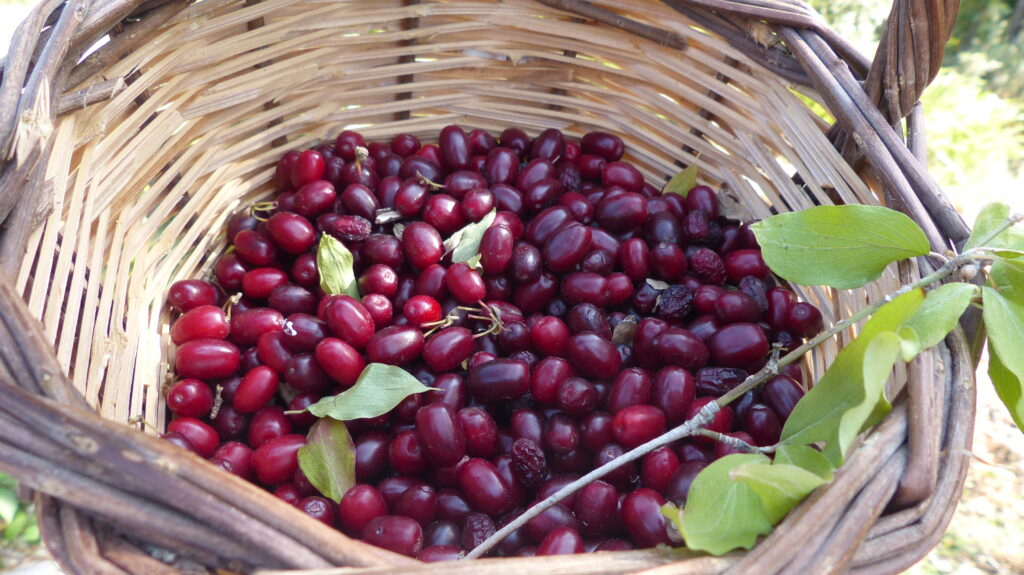
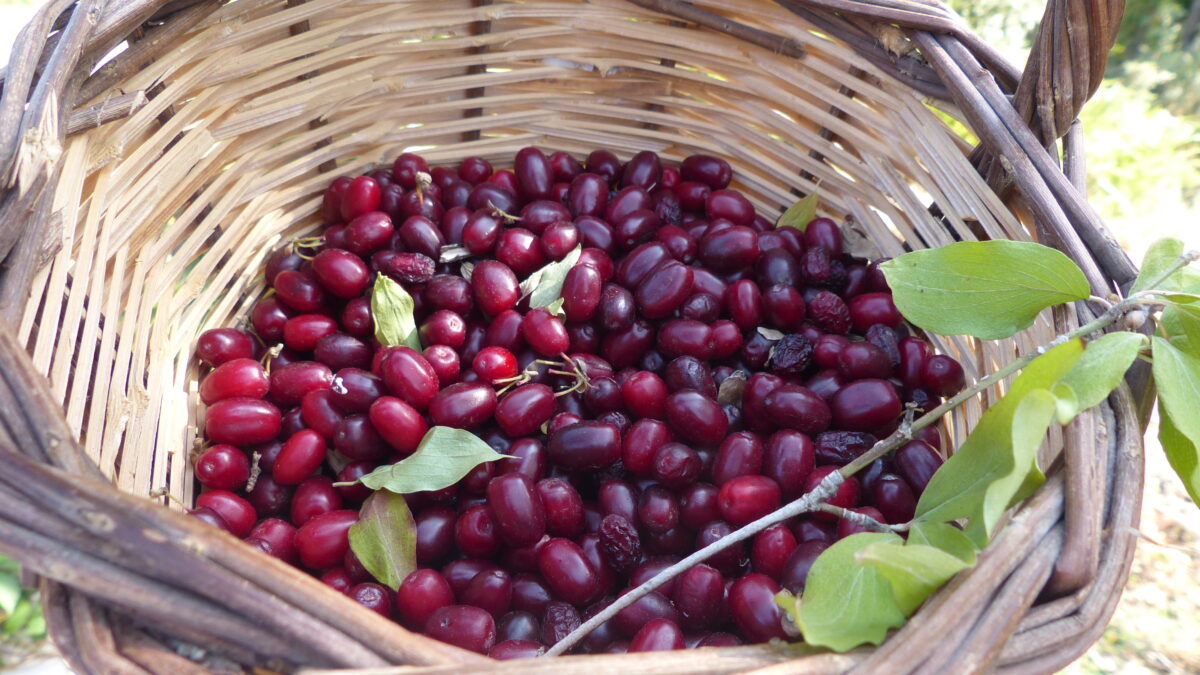
Image 1. Cornelian cherries gathered from Cholomon, in the wider area of Taxiarchis in the mountains of Chalkidiki, September 2021. Photograph by S.M. Valamoti
Theophrastus makes various references to the botanical attributes of Cornelian cherries in his Enquiry into plants, while in his On the causes of plants he notes that the tree resists domestication and its fruit become less sweet the more it is watered and fertilised.
Today, Cornelian cherries are primarily used to make liqueurs or marmalades. Recipes for these may be found in cookbooks covering the cuisines of specific regions, such as Pontus or Western Macedonia (e.g. Florina, Kozani). Liqueurs or marmalades made from Cornelian cherries can also be purchased from various agricultural cooperatives and home workshops, especially in the regions of Almopia, Vermio, Pieria, and Serres in Macedonia, Evrytania in Central Greece, and various areas of Thrace and Thessaly. Cornelian cherries are a seasonal fruit, available when ripe at local farmer’s markets in areas where they grow in the wild.