 Ελληνικά
 Deutsch
 Français
 Svenska
 Türkçe
 한국어
한국어 Suomi
Suomi







Soultana-Maria Valamoti, Professor, School of History and Archaeology, Aristotle University of Thessaloniki
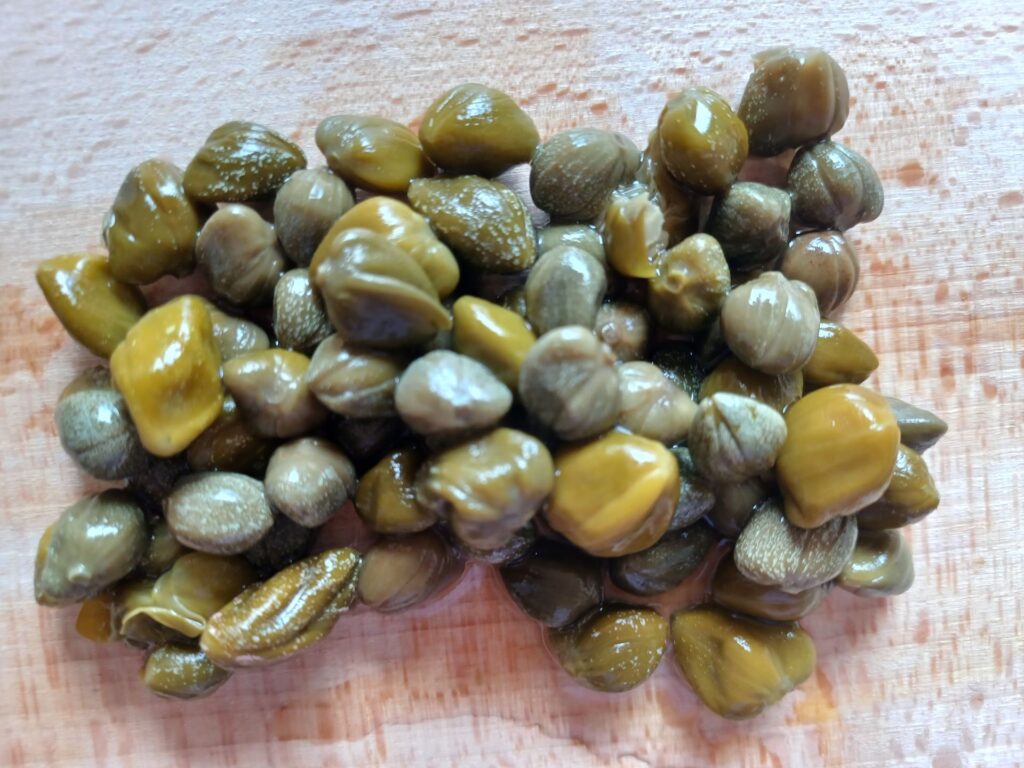
Capers are shapely plants that grow in maritime regions, as well as more inland, throughout the Mediterranean basin. They usually grow in uncultivated fields or among crags, in ruins and on old walls. The flower and fruit are delicacies with intense flavour, and are usually preserved in brine and vinegar. Caper seeds have been discovered at archaeological sites in Greece, such as Makri in Evros, however these findings are sporadic, with amounts generally remaining low. This is to be expected, given that the plant’s edible parts, i.e. its flowers, fruit, and leaves, are entirely unlikely to be preserved in archaeological deposits. Nevertheless, we possess a wealth of fascinating knowledge on how the ancient Greeks used capers, thanks to the many references to the plant in ancient texts. The earliest reference to capers dates to the 5th c. B.C. and is found in the Hippocratic corpus, where the skin of its roots and its fruit are used as ingredients in pharmaceutical formulas.
There are numerous examples of this in the Hippocratic texts. One such case is a formula that combines capers with honey, vinegar, pepper, nitre and water to create a mild expectorant (On diseases). Freshly ground caper leaves or caper root skin soaked in dark red wine are recommended as poultices (On fistulae). The pseudo-Hippocratic On various foodstuffs, for Ptolemy describes capers as ideal for stomach pains, good for the digestion (ευστόμαχος), and useful for cleansing the liver and the spleen. Dioscorides (1st c. A.D.) also expounds on the medicinal properties of capers.
Theophrastus (4th – 3rd c. B.C.) classifies capers among the herbaceous plants, noting that they do not “προσδέχεται γεωργίαν”, i.e. take to cultivation. The caper is thus something of a wild plant (Enquiry into plants and On the causes of plants), a classification also found in the later pseudo-Aristotelian Problems. Ancient texts paint a vivid image of the interaction between man and nature, a process in which wild plants occasionally refuse to bend to man’s will to domesticate them.
As for flavour, Theophrastus (On the causes of plants) notes that they are remarkably sharp. According to the ancient Greek writers, capers were a widely enjoyed delicacy. As such, they appear in lists of foods preserved in the works of old comedy, such as those of Alexis (4th – 3rd c. B.C.), Antiphanes (4th c. B.C.), and Philemon (4th – 3rd c. B.C.), together with garlic, onions, and cheese, or with vinegar, oregano, cumin, olives, or asparagus, fish etc.
In their capacity as a condiment served with tsipouro or ouzo or sprinkled over fava, capers continue to turn everyday ingredients into unique dishes thanks to their intense flavour, whether cooked with tomatoes in the fava served throughout the Aegean, or served with onions as a side to the dish. With a history in Greece tracing back to prehistoric times, wild, tangy capers have been a perennial presence in the cuisines of the Aegean and the wider Mediterranean.